Aliens Are Kinda Out There, Man
Morning comes, and you wake and you mourn and you long for coffee to mourn a little faster. They say we are the middle children of history: born too late to explore the earth, and too early to explore space. Must we be doomed to such a quick eternity? Why not use our imagination to step ahead of our time?
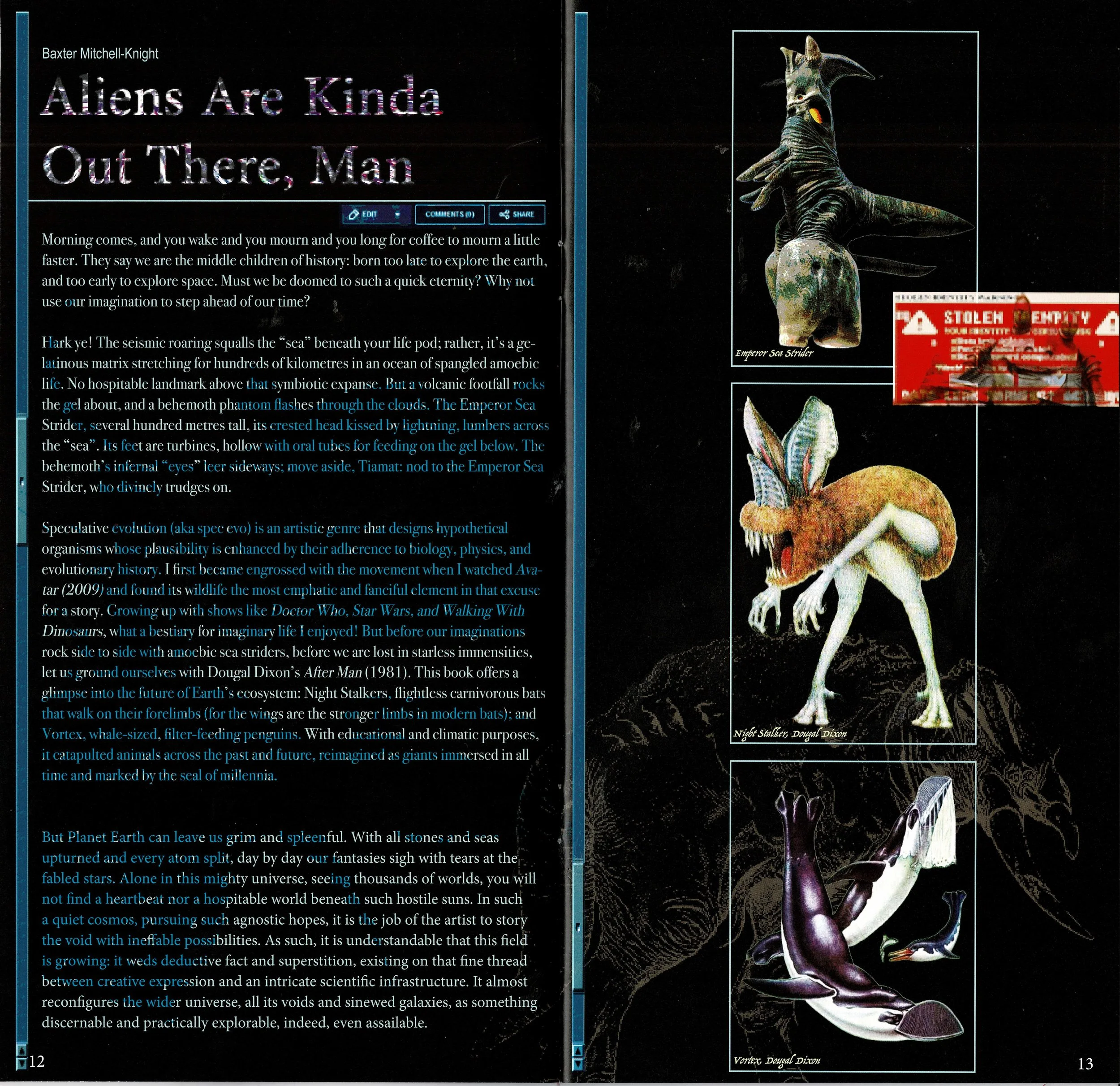
Hark ye! The seismic roaring squalls the “sea” beneath your life pod; rather, it’s a gelatinous matrix stretching for hundreds of kilometres in an ocean of spangled amoebic life. No hospitable landmark above that symbiotic expanse. But a volcanic footfall rocks the gel about, and a behemoth phantom flashes through the clouds. The Emperor Sea Strider, several hundred metres tall, its crested head kissed by lightning, lumbers across the “sea”. Its feet are turbines, hollow with oral tubes for feeding on the gel below. The behemoth’s infernal “eyes” leer sideways; move aside, Tiamat: nod to the Emperor Sea Strider, who divinely trudges on.
Speculative evolution (aka spec evo) is an artistic genre that designs hypothetical organisms whose plausibility is enhanced by their adherence to biology, physics, and evolutionary history. I first became engrossed with the movement when I watched Avatar (2009) and found its wildlife the most emphatic and fanciful element in that excuse for a story. Growing up with shows like Doctor Who, Star Wars, and Walking With Dinosaurs, what a bestiary for imaginary life I enjoyed! But before our imaginations rock side to side with amoebic sea striders, before we are lost in starless immensities, let us ground ourselves with Dougal Dixon’s After Man (1981). This book offers a glimpse into the future of Earth’s ecosystem: Night Stalkers, flightless carnivorous bats that walk on their forelimbs (for the wings are the stronger limbs in modern bats); and Vortex, whale-sized, filter-feeding penguins. With educational and climatic purposes, it catapulted animals across the past and future, reimagined as giants immersed in all time and marked by the seal of millennia.
But Planet Earth can leave us grim and spleenful. With all stones and seas upturned and every atom split, day by day our fantasies sigh with tears at the fabled stars. Alone in this mighty universe, seeing thousands of worlds, you will not find a heartbeat nor a hospitable world beneath such hostile suns. In such a quiet cosmos, pursuing such agnostic hopes, it is the job of the artist to story the void with ineffable possibilities. As such, it is understandable that this field is growing: it weds deductive fact and superstition, existing on that fine thread between creative expression and an intricate scientific infrastructure. It almost reconfigures the wider universe, all its voids and sinewed galaxies, as something discernable and practically explorable, indeed, even assailable.
Because the alternative is bleak. Turning to the sky, we are stabbed by the thought of the void; its limitlessness shadows an existential loneliness that is darkened further by its appeal to our imaginations. But we risk gazing ourselves blind at the vast shroud of atheism that wraps around our planet. Spec evo, then, can be understood as atonement for our cosmic loneliness. Lovecraft and Fermi echoed the universe’s maddening silence back at us but left us dazzled; how shall we comfort ourselves with all this blankness in our eyes? We push off from our human isle and swoop the unbodied universe with our madness: spec evo ignites the stars with vitalism and possibility.
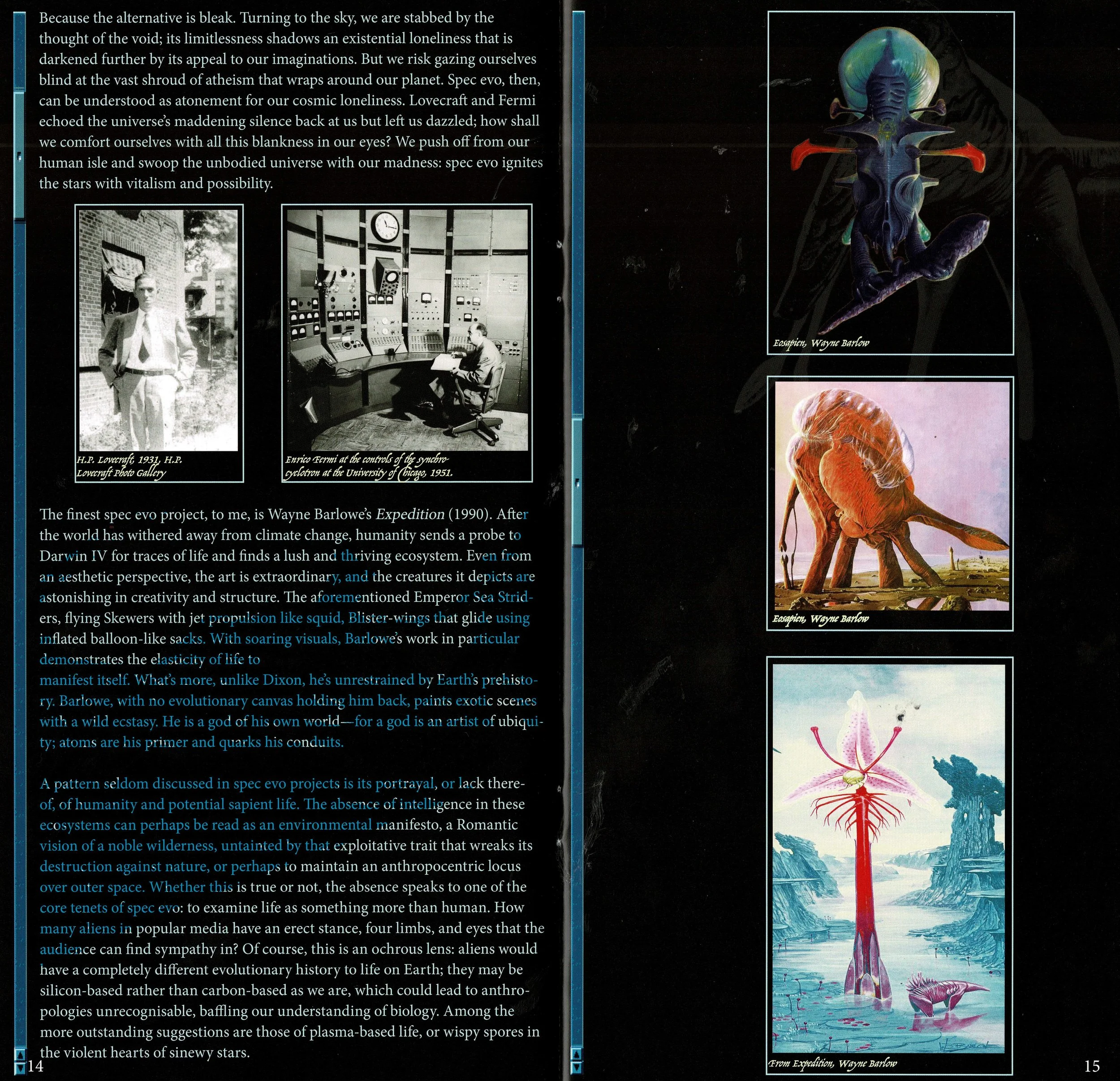
The finest spec evo project, to me, is Wayne Barlowe’s Expedition (1990). After the world has withered away from climate change, humanity sends a probe to Darwin IV for traces of life and finds a lush and thriving ecosystem. Even from an aesthetic perspective, the art is extraordinary, and the creatures it depicts are astonishing in creativity and structure. The aforementioned Emperor Sea Striders, flying Skewers with jet propulsion like squid, Blister-wings that glide using inflated balloon-like sacks. With soaring visuals, Barlowe’s work in particular demonstrates the elasticity of life to manifest itself. What’s more, unlike Dixon, he’s unrestrained by Earth’s prehistory. Barlowe, with no evolutionary canvas holding him back, paints exotic scenes with a wild ecstasy. He is a god of his own world—for a god is an artist of ubiquity; atoms are his primer and quarks his conduits.
A pattern seldom discussed in spec evo projects is its portrayal, or lack thereof, of humanity and potential sapient life. The absence of intelligence in these ecosystems can perhaps be read as an environmental manifesto, a Romantic vision of a noble wilderness, untainted by that exploitative trait that wreaks its destruction against nature, or perhaps to maintain an anthropocentric locus over outer space. Whether this is true or not, the absence speaks to one of the core tenets of spec evo: to examine life as something more than human. How many aliens in popular media have an erect stance, four limbs, and eyes that the audience can find sympathy in? Of course, this is an ochrous lens: aliens would have a completely different evolutionary history to life on Earth; they may be silicon-based rather than carbon-based as we are, which could lead to anthropologies unrecognisable, baffling our understanding of biology. Among the more outstanding suggestions are those of plasma-based life, or wispy spores in the violent hearts of sinewy stars.
I was always a more improvised architect of life. You start with the wild pencil strokes in all directions. Then, as though faced with a rorschach test, the hand interprets a concentrated body from the chaos. This is how I have engaged with the medium, and it is a good practice, regardless of whether you are scientifically inclined or not, to exercise your subconscious creativity. I ask you to rest your head against the paper and scribble some lines in all directions and see what incantation of an animal is conjured from your pencil ritual.
Scientific speculation is an intriguing kind of madness, the demoniac kind that gambles its faith within its laws. It allows us, trapped in modernity—the pastiche of life—to take on a unique challenge in peeking with the imagination at the boundless possibilities that life realises. There is a childlike sacredness in this process, as though we forget how young we are and propel our potential on interstellar voyages.
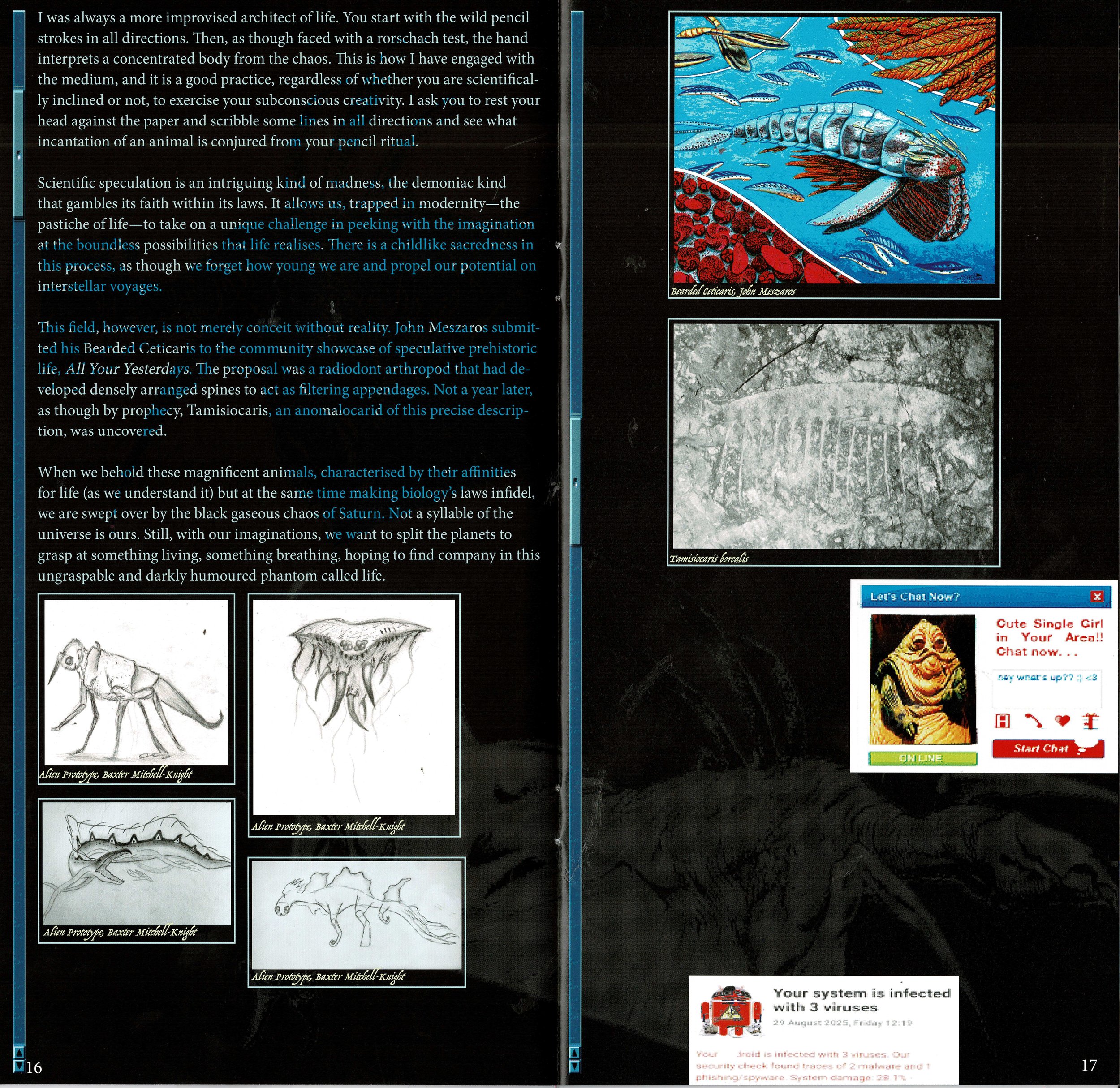
This field, however, is not merely conceit without reality. John Meszaros submitted his Bearded Ceticaris to the community showcase of speculative prehistoric life, All Your Yesterdays. The proposal was a radiodont arthropod that had developed densely arranged spines to act as filtering appendages. Not a year later, as though by prophecy, Tamisiocaris, an anomalocarid of this precise description, was uncovered.
When we behold these magnificent animals, characterised by their affinities for life (as we understand it) but at the same time making biology’s laws infidel, we are swept over by the black gaseous chaos of Saturn. Not a syllable of the universe is ours. Still, with our imaginations, we want to split the planets to grasp at something living, something breathing, hoping to find company in this ungraspable and darkly humoured phantom called life.