
PULP Reviews: Short Wave x Soft Centre Film Screening at the Sydney Opera House
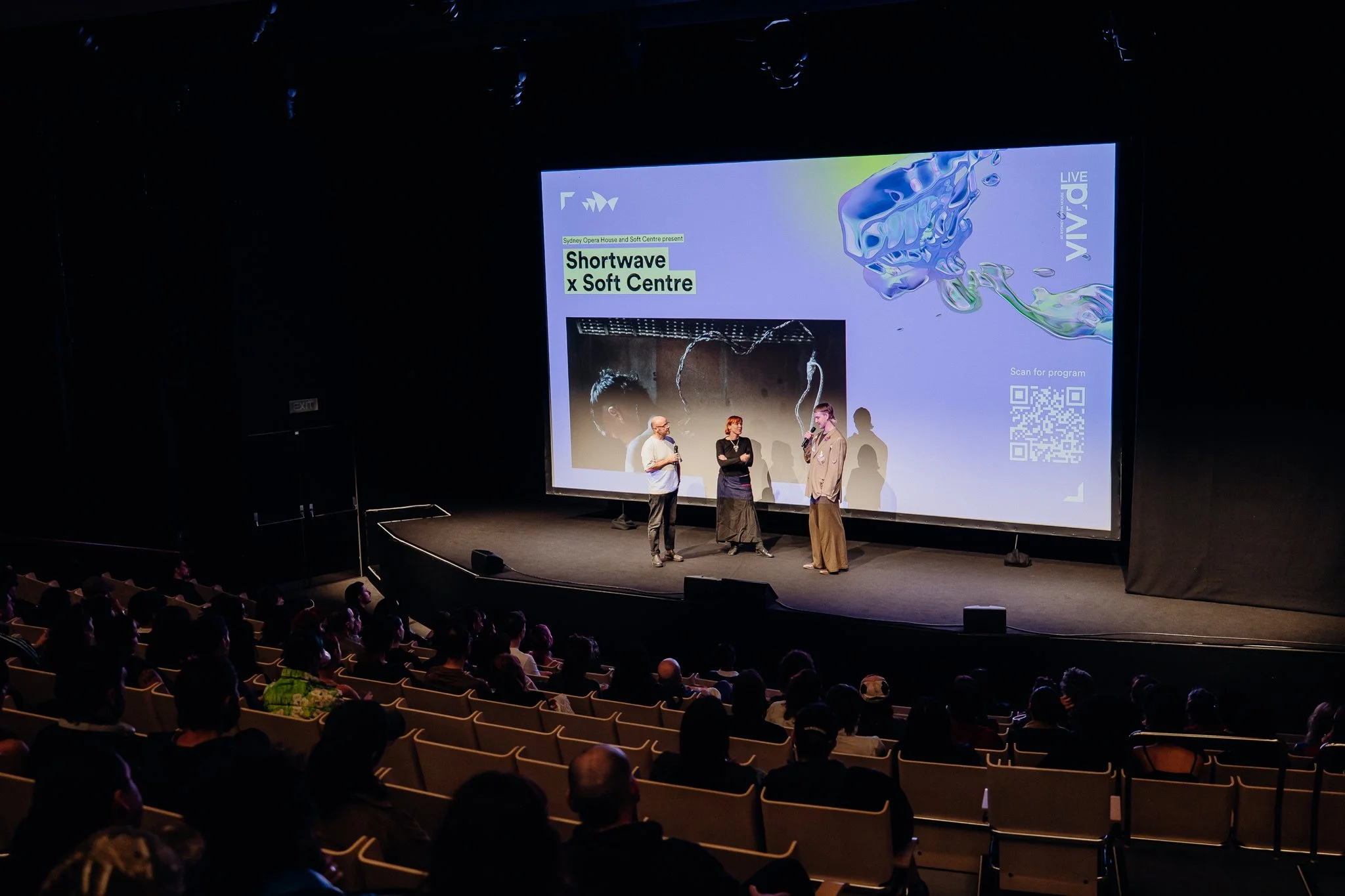
Image credit: Jordan Munns
In the ever-digitised world of today, what does it mean to be human? Inescapably, almost cyborgial in attachment to our technology, how do we see, feel, act, and appear? Have the boundaries of ‘humanity’ shifted from our innate wild nature towards a definition fractured by the consuming landscape of the internet?
Such were the gnawing questions and reflections that arose when the lights came on after the Shortwave x Soft Centre film programme shown at the Sydney Opera House during Vivid—a lingering vacant stare into the self, and then down to the humming machine in my pocket.
An hour and a half prior, we were scrambling around the underbelly of the opera house. Shuffling from counter to counter, door to door, to get our bags checked and tickets scanned before the screening started. We were met with a similar crowd to ourselves. Mostly young, and all very stylish—those you recognise as your personal local celebs. The cool creatives you know (yet are ignorant of your existence) were all present.
Inside the playhouse theatre, the mumbling crowd fell into a well-oiled silence as the music tapered out. The presenters took the stage, and the evening began with introductory speeches about the aims of this collection by Shortwave, the screen commission programme of the Sydney Opera House, and Soft Centre, the uber-cool contemporary art/events group. Together, they curated a selection of 8 short films and commissioned one work from artist Passive Kneeling. The selection, we were informed, would emulate and go beyond direct social media core-core edits, exploring ideas surrounding our connectivity to the internet through more “technical” audiovisual craftsmanship. The digital scrappiness of online edit aesthetics thus melded together with pixelated footage, 3d rendering galore, and soulfully written yet distorted recordings.
I sat, legs crossed, notebook and pen at the ready to jot down notes on nine entries to come, poised in preparation for this review. Yet, besides the occasional title page, the films flowed with such natural grace that I barely even noticed their progressions. The series moved as though chapters of one larger story. Impressively fluid in its navigation of ideas, given the organisers' claim that this was the first time all films would be screened in sequence.
Starting the evening, A Weak & Panicked Animal (2024) by Jake Starr, instilled the underlying question of humanity that would be explored throughout the collection. Appearing at first like a harrowing crime documentary, only to bait-and-switch us with the curiously and surprisingly frequent incidents of deer break-ins, the film presented to us what happens when nature crosses our boundary of civility. Agile hoofs and antlers crashing through windows, floundering on unnaturally slippery floors. The violence, fear, and panic with which we react to such interactions reflect just how disjointed we are from the outside world. Shown almost entirely through grainy digital security camera footage, Starr perhaps proposes that humanity, and our emotional reactions and behaviours, are now manufactured and distant, lofted high on a ceiling through pixelated eyes. Screeching and haunting, this initial film struck a lingering chord as an eerie rumination, furthering the programme’s questioning of the boundaries of humanity. Where do we end and where do we start in our new realm of natural, real, and now digital life?
The next chapters immersed us fully in the digital, as though stepping into a video game. First-person POV shots with outstretched player hands, click and zoom style films, or the uncanny valley backroom-esque nature of the rendering all melded together worlds of real and unreal. Environments and visuals distorted through the lens of the web, lives placed in a falsified, derealised plane. ‘Flay’ (2026) by Zein Majali, exploring the augmentation of faces a la Sophie’s Faceshopping, created a sensation of the world seeping away from the bones of reality and leaving a zombie-like rumination on what's left. A glitchy, yet fleshy, form of self-optimising, internet face. More subtly in works like Mark Leckey’s To the Old World (Thank You for the Use of Your Body), 2021, which toyed with the notions of replay and remixed footage, the self not only becomes inserted into, but warped and augmented for the internet. Taking found footage of a guy smashing through the glass of a bus stop, the piece rewinds, repeats, reinterprets, and distorts the image and audio to a climax of disturbing humour, recalling this loud, almost horrific memeification of the mundane human. Taking and questioning how, even in a drunken state, we perform stupidity for the sake of internet interest. Then replay the footage over and over to the point of disruption. Through such works, the self becomes inseparable from our digital persona. Cyborg-like in our physical and mental attachment to digital technology.
Such connectivity was not merely shown as a delirious nightmare, but at times beautiful, serene, and nostalgic. These new tech infrastructures became false palaces, reminding us of the beauty of nature's chaos. The Sun Will Rise (2023) by dampwetbody, a meditative poem on how the mundane, stupid, and exuberant occurrences of day-to-day life pass by, the sun continues to rise in a kaleidoscopic beauty. I only experience things in latent space now (2026), from Aakarsh Singh, exemplified the construction of the self on the internet. Through nostalgic yet natural glitchiness, the film filters through the memory of the internet, illustrating its role in defining self-identity as an almost serene and vivid nature. A more hopeful side to the bridge between the digital and outside worlds we inhabit.
Commissioned for Vivid 2026, ‘Echo Sleep’ (2026) by Passive Kneeling was a succinct summation of the above themes. Beginning in a video game-esque but beautifully lit room, the film slowly dissolved into a void of epic horror. Trapped away from one's true thoughts, the digital world becomes a monster harbouring one's identity from the individual. Like an internet-born ‘Stranger Things’ (2025) finale, memory and data turn against the POV player, keeping them from actualising their true self beyond the now derelict plane of reality. What we consume, create, and view becomes inherent to our humanity, but also represents a daunting palace for capital consumption and control. The finale captures why the previous works seemed so daunting. This lurking fear of that which we increasingly rely on or are trapped within, but do not ourselves control.
We walked out of the theatre onto the harbour, the lights and video projections of Vivid ablaze against the Opera House’s facade. Digital, swirling, mutations of butterfly wings and flowery petals, encompassing our plane of natural human existence. Looking at the spotlights in the clouds, we paused to reflect on the screening but also wondered how the bright lasers might affect flying birds and passing planes. It was a poignant ending to the evening. Leaving the hour of digital frenzy ripe with new questions, only to walk into a realm infringed upon by further digitised images and attractions.
I feel, though, that even if daunting and horrific, the short films we saw acted as a precautionary tale. A story from the depths of the technological trenches, by those who create and work with the digital for their art and inspiration, that warns us to take heed of the world outside. A story to remind us that humanity exists not solely in our laminate floor offices, white wall rooms, and screen-ridden pleasures. That we should let nature break across that boundary, lest we become the frail fragments of a creature bound not to earth but to a digital realm.