
Simple Beautiful Things
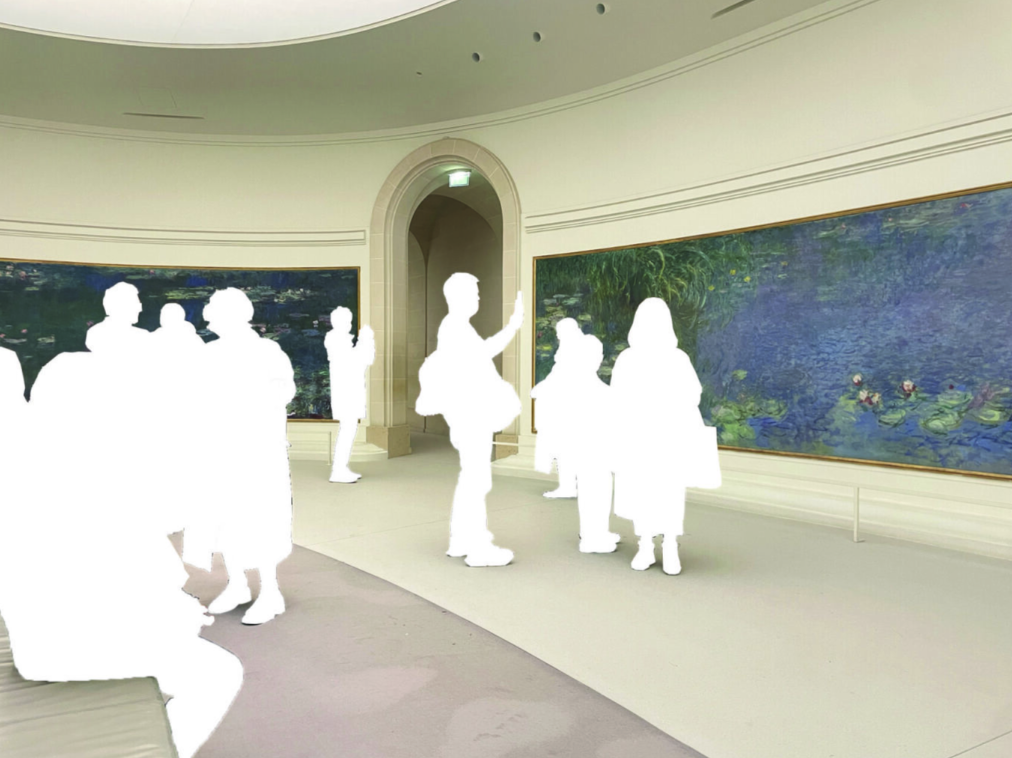
In Paris, visitors queue, the cuffs of their pants muddied by the sodden paths they traipse over in order to reach the Musée de l’Orangerie. After interacting with the most pompous security guards on Earth, having their bags searched as though they are about to embark on an international flight, and parting ways with €12.50, they finally enter the museum.
Eight panels of Claude Monet’s Nymphéas (Water Lilies) (1914–1926) are housed inside the Musée de l’Orangerie, within two egg-shaped rooms that were designed specifically to display the paintings. Crowds gather from morning to evening, eager to glimpse the canvases that hang inside. At almost two metres tall, the Water Lilies hang across the curved walls of the museum, enveloping viewers in tranquil scenes. Delicate chains of willow tree leaves dribble down the canvases and swirls of pink gather amongst light blue brushstrokes, creating rippled pools and soft light. Green lily pads are scattered over the surfaces of the water. However, the sheer number of selfie sticks clasping phones that capture people in front of the works brings another dynamic into the space. I strongly believe that the more visitors galleries receive, the better. Anyone who can be bothered to trek it on the metro, deal with the ridiculous French security system, and pay a hefty sum to see some art is my kind of person. What fascinates me is why these works in particular are so popular and what they signify in the contemporary world.
For starters, the Water Lilies are beautiful to look at. Monet’s compositions belong to the broader art movement of Impressionism which began in the late 19th century. Characterised by visible brushstrokes, depiction of light, and ‘ordinary’ subject matter featuring landscapes, still lifes, and interior scenes, Impressionist artists resisted the narrative and figural painting style of the time. Organised by a group of artists called the Anonymous Society of Painters, Impressionism was initially unified by its independence from the official salons. At the time, conservatives criticised the works for their “unfinished” appearance, but others, such as Edmond Duranty, in his 1876 essay La Nouvelle Peinture praised the Impressionists for depicting contemporary subject matter in a new style. In one of the panels, Les Deux Saules (The Two Willows), a chocolate coloured tree curves up the left-hand side of the canvas, arching over the pond below, as though the willow is bending to trail its branches over the water’s surface. In Le Matin Clair aux Saules (The Clear Morning at the Willows) Monet employs shorter brushstrokes in pale tones to create undulations of light over the pond. Deep greens are flicked onto the canvas, depicting vibrant lily pads and their flowers. Philosophers of aesthetics describe how beauty, whether in nature or art, transports us from our everyday lives to states of contemplation. Whether you’re seething because someone in your hostel snored all night, or you lost your favourite scarf at La Gare Le Gore, the beauty within Impressionist paintings allows one to forget about the nuisances in their lives and appreciate the tranquil beauty of the works.
The Water Lilies are popular because they are beautiful, but the hunger of the audiences to post photos of themselves with the paintings demonstrates that they also signify a kind of social status. Museum institutions play a role in constructing this reputation of Impressionist art. In the Musée de l’Orangerie, the eight panels of the Water Lilies are displayed in elliptical-shaped rooms that draw out the mathematical symbol for infinity. The fact that the paintings are housed in specifically designed salles elevates their status. As a result, the Water Lilies are the reason why the museum is visited. The same goes for the Musée d’Orsay in Paris. Although this enormous museum displays everything from grand paintings by Courbet to the famous Pompon polar bear sculpture, the main attraction is the collection of Impressionist artworks. Housed on the top floor of this train station-turned museum, people crowd around works by Degas, Manet, Pissarro, and Monet. At the entrance of the Orsay museum, signs point visitors in the direction of the Impressionist collection, guiding people towards these works. Even the choice to display the Impressionist paintings on the top floor of the building physically signifies their value. If Impressionism was on Dance Moms, it would be at the top of the pyramid. Part of me worries that Impressionist paintings have been elevated to this status because they are easy or inoffensive to look at, or because they are generic enough in subject matter for anyone to enjoy. Aesthetic theories argue that beautiful works of art bring solace in times of distress. Perhaps in this time of global political turmoil, the serene imagery of the Water Lilies provide consolation, attracting many.
Although one might argue that the palatable and consoling nature of Impressionist paintings renders them as apolitical pieces that say nothing about the society we live in, I believe that works like Monet’s Water Lilies subtly challenge the world around us. If we compare a gruesome painting like Francisco Goya’s Saturn Devouring His Son (1820–1823), to the Water Lilies, the obvious depiction of violence in Goya’s painting highlight the political themes he was depicting of the horrors of the Peninsular War (1808–1814). However, Monet painted the Water Lilies in response to the horrors of the First World War (1914–1918). In fact, the Water Lilies housed in the Musée de l’Orangerie were gifted by Monet to the French State after the Armistice with the intention to give the nation a monument dedicated to peace. Both Goya and Monet respond to war in their paintings, however, Monet’s delicate works depicting his Giverny gardens are certainly more popular in the present day. Monet’s decision to gift his paintings to the State as a symbol of peace highlights the subtle political nature of these works. Susan Johnson (2009) describes how “suffering is beauty’s twin” and that “death give[s] beauty its meaning”. Monet employs deep greens, swaying willows, and soft light within the Water Lilies to connect death to beauty and solace. Additionally, the innovative nature of Impressionist painting at the time contributed to the subtle questioning of society. Nowadays, Impressionist painting is not viewed as revolutionary, but I argue that its roots in independence from the official salons influence us more than we know.
Although it may be tempting to view the Water Lilies and Impressionist paintings in general as simple beautiful works that people flock to to use as a nice background for their instagram photos, I believe that the popularity of Impressionist work in contemporary society is more nuanced. We cannot deny that the beauty of the Water Lilies attracts many. Monet's intention to render these picturesque garden scenes was grounded in the desire to create a monument of peace after the First World War, highlighting the subtle political themes within his work. As philosophers of aesthetics outline, death gives beauty meaning. Perhaps the popularity of the Water Lilies in the present day demonstrates the power of beautiful art in bringing people together and subtly restructuring our perceptions of politics.