
An overcast Sunday morning at the Sydney Opera House: Review of Zadie Smith in conversation with Michaela Kalowski
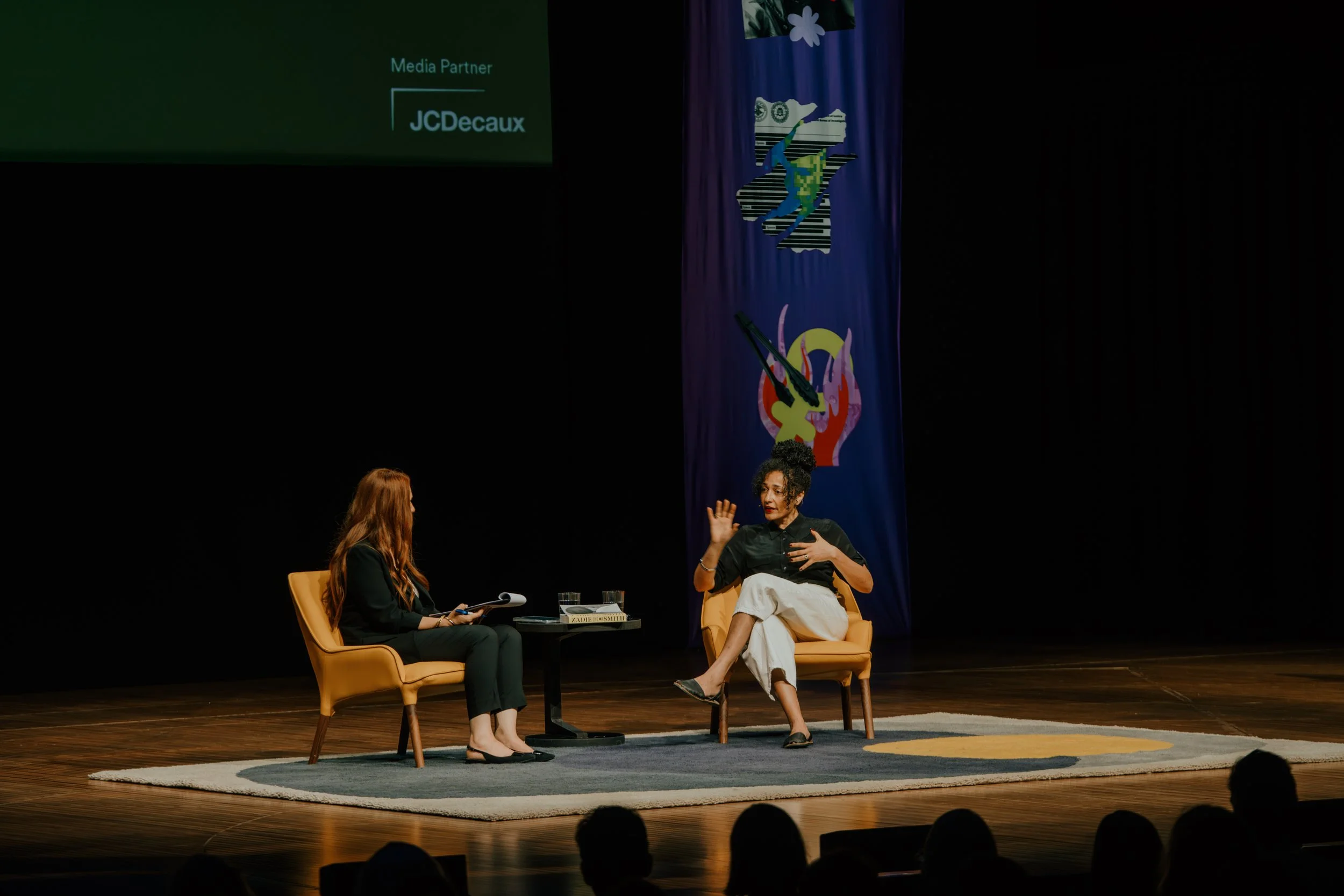
Zadie Smith’s event took place at the Sydney Opera House on Sunday 8 March.
The annual headline talks festival for Sydney Opera House’s annual All About Women starts with all the cliches of a large public event. Queuing for the metal detector entrance, inching along behind crowds of slow walkers, the chatter overlayed so that you can’t even eavesdrop. I scan my ticket and enter the foyer.
In the bar outside the concert hall I wait for my friend to join me. The women behind me are talking about the book Swing Time by Zadie Smith, the author we are waiting to see. I notice the majority of this crowd are women. Women of all different ages and styles of dress have come together. Some in groups, some alone, some in couples, many carry a newly bought book (most commonly Zadie Smith’s Dead and Alive), some have coffee, more have wine. People stream past and the words in the air are Zadie Smith. In this building, backstage, in a green room tucked away is the Zadie Smith. The soundsystem begins to ring. ZS is coming! She is almost here. The noise ticks and beeps. 5 minutes to 1 o’clock. I jot down some notes and the bar empties out around me.
Inside the auditorium: the audience is packed, people find their seats and electronic dance music plays over the speakers. The concert hall is huge, a cavernous room with a spotlight aimed at centre stage. I am only eleven rows from the stage. 2500 people wait for two empty armchairs to be filled.
Afterwards, I sit in a cafe, it’s raining and I try to arrange my thoughts. I was given these tickets in exchange for writing this very review, dear reader. But what’s the angle? What just happened?
ZS started the conversation with a joke. She asked: Why are you here? It’s a fair point. Why did 2,500 people on the other side of the world gather to watch her, as she puts it, “do nothing but talk”? Maybe it’s her self-deprecating humour. I prefer to think of it as the persistent scrutiny of a writer who can’t help but question.
Most of the conversation centred around ZS’s most recent book, Dead and Alive (2025), an essay collection featuring cultural criticism, analysis and reflection. The interviewer would quote a particular phrase from one of her essays and ask for elaboration. For each quote ZS explained her thoughts behind the essay, dropping tidbits about what she was doing at that time in her life, how it connected to her work. The essay collection covers everything from Stormzy to Joan Didion, her memories of teenagedom to the art exhibitions she has seen. Mirroring the variety of her work, the conversation was broad. The discussion meandered from White Teeth (her first novel in 2000) to her thoughts on philosophy of language. From her writing process to Sally Rooney and David Szalay. ZS spoke about her childhood in London and her children who are teenagers now.
At some point the interviewer asked about social media. Famously, ZS doesn’t use a smartphone. She said she wouldn’t describe herself as offline. She has a computer, but it stays on her desk, she doesn’t want it in her pocket. They discussed social media in particular, the way it drains people, the experience of timelessness while scrolling and the hours you can’t ever get back. ZS said “we are literally going to be dead soon”—why waste your time? She pointed out the corporate manipulation of social media users and the distortion social media creates. In one of her essays she quotes “this is your brain on algorithms”. The internet changes the way our brains operate, it enters our speech, our thinking, our consciousness. Since her decision to opt out, ZS said being away from the internet has benefited her writing. She thinks when people are swimming in it daily they crave something that “doesn’t smell of the algorithm”. Maybe it’s because she’s offline, maybe because she’s a brilliant writer but her sentences have a refreshing quality. Reading or listening to ZS is like coming up for air after watching 87 different tiktoks all on the same thing. You can feel that originality in her essays.
So why were we all there? Because ZS is a person even more interesting than the characters she writes. She is one of the greatest essayists of our time. Her manipulation of language has resonated with readers all over the world since she started her career at only 23-years-old. Why does anyone go to writers' talks? We want to know how they did it. How she took hold of our imagination, how she became so intelligent, so talented, how she accomplished so much. We want to know how she thinks, we want to know where it came from. Zadie won’t tell us, she makes us laugh and she makes us think but she won’t give us what we really want. She withholds an answer. In her words, reality is complicated. You only get partial understanding. This is part of the appeal of her work, by embracing inconsistency she creates clarity. Maybe you think that’s paradoxical? I’d agree. ZS is prickly, she doesn’t give you a complete persona.
Immensely intelligent, gorgeous and well-read. If you are jealously-prone, it's difficult to like ZS. That seems okay with her. She jokes, “why would I apply for the love of strangers? I don’t know you.” On the cover of Dead and Alive is a photograph of her turned away from the camera. She offers her words, but only the words. When you can write sentences like Zadie Smith, you are above explanation.