
Love, Death, Knitting
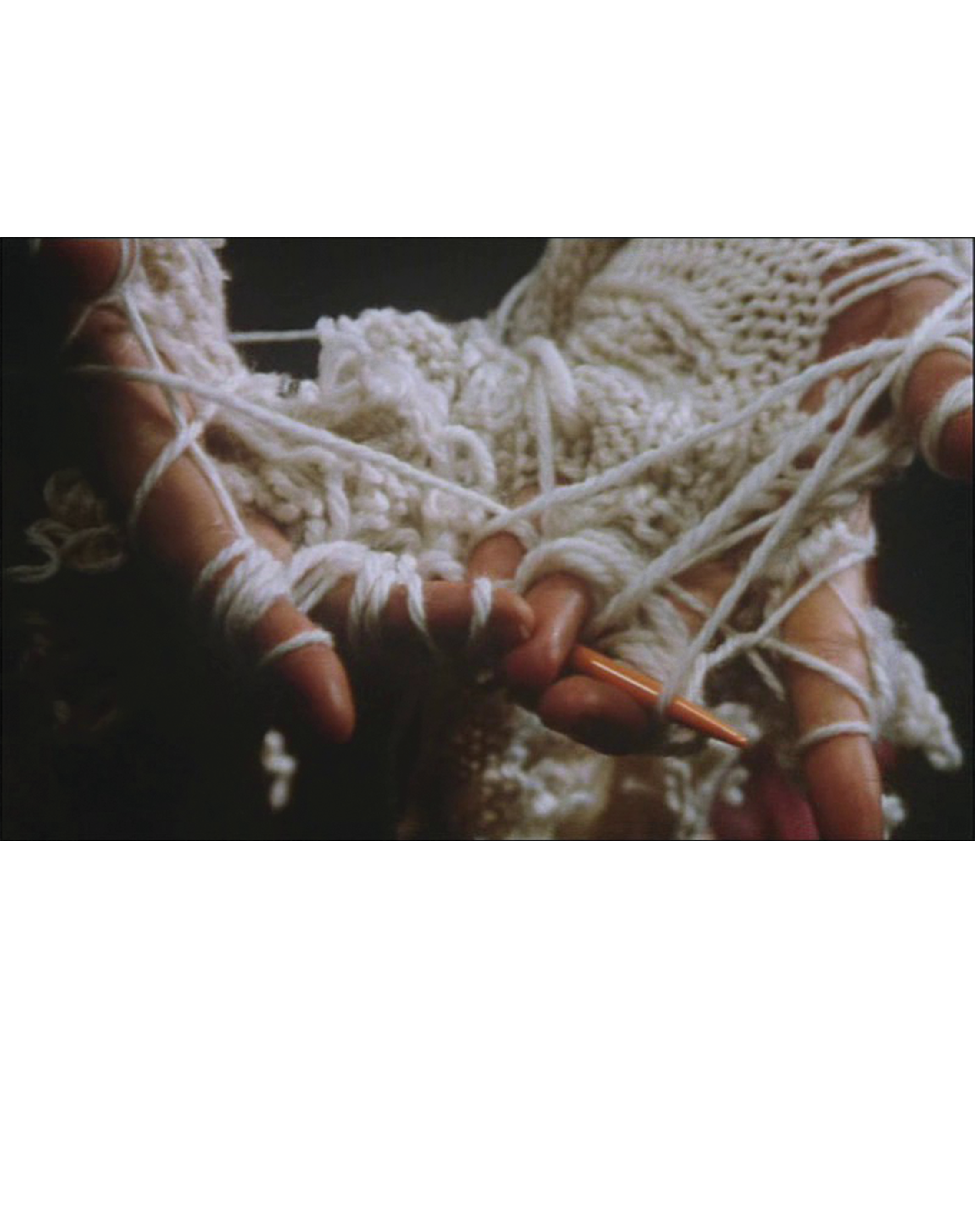
Two years ago I started working in a wool shop, and everything (especially knitting) seemed to be a matter of life or death. Stitch gauge was death. Needles were death. Baby clothes were the glimmering reprieve of life.
When I applied for the job, I could only crochet. I had moved home after my first year in Melbourne and was trying not to consider the whole thing a colossal failure. I was having a year off. With only two close friends in Sydney—one studying law, the other in the middle of a prolonged depressive episode—I spent all my free time learning how to knit. I had slipped into an auxiliary universe of knowledge; the least I could do was land on my feet.
The first thing you should understand about knitting is that, as with any form of learning, it makes some people deeply and profoundly terrified. It can produce enough fear to make a retiree spend $1.4k on cashmere, despite the fact that they don’t know how to knit. They are just getting ready to learn how to knit. A few days after my pitch was approved for the article you’re reading right now, I told my coworker E what I planned to write about. She turned to me, her face grim, and said, “you have to send them all up.”
The second thing you should understand is this: we have no power. This is always the case in retail, and especially as a young person, who is powerless anyway. Sometimes customers just want to send up the 21 year-old working behind the counter. We abide by the edict that the customer is always right, including when they are wrong. I couldn’t tell someone how long it would take to knit a jumper. Would they be using four-ply wool or twelve-ply? How many hours a week would they knit? If they got to a hard part, would they keep going, or give up? Knitting advice started to become less a part of the job and more an exercise in inhabiting someone else’s life. Here was something for me to do: become other people.
Spending Thursday to Sunday staring at colours, H decreed that I was in my pink phase. A part of me wanted a return to childhood—before I learnt that pink was wrong, and that being a girl was wrong, and when the women I met weren’t so quick to remind me of this. I was very lonely.
In the two years since (back at uni, my law friend a true BNOC, my other friend using a different name, a lot happier), I have learned that loneliness is easily forgotten. A 2025 University of Sydney report by Lim and Smith found that over two in five people aged 15 to 25 feel lonely. Why? Is this a condition of being alive, or are we in a space of acute vulnerability? Olivia Laing writes in her book The Lonely City: Adventures in the Art of Being Alone (2016) that,
Amidst the glossiness of late capitalism, we are fed the notion that all difficult feelings [...] are simply a consequence of unsettled chemistry, a problem to be fixed, rather than a response to structural injustice, or, on the other hand, to the native texture of embodiment, of doing time [...] in a rented body, with all the attendant grief and frustration that entails.
Evidence of someone else’s loneliness makes us cringe away; we register it, on some level, as contagious. Nevermind that these rented bodies are only reflections of other, separate lodgers, renters equally unmoored. We prefer to forget it.
But here I had… community? Sort of. At work, we had big tables where anyone could sit, even if they weren’t buying. When an old lady called and rambled, I could talk to her for ages. One of the first things A told me when I started was, “some people come in here just looking for conversation.” Every request for another ball of wool was actually an opportunity for my undivided attention. In the middle of this enormous city, I heard about husbands, daughters living in London, parents in nursing homes, and babies. In not so many words I came to witness the entire breadth of the human experience—which boils down to love, death, and knitting.
It was still retail, though. If customers smelled a whiff of weakness in me, they would drive the blade home for a refund or a discount. After an hour of helping a customer with her pattern, she paid for her new project.
She said to me, “thanks for your help. I don’t mean to be rude, but I hope I never have to see you again.”
It was better than other jobs I’d had. The summer before my HSC, I worked at David Jones on the shoe level. I spent the interminable ten-hour shifts pacing the carpeted floor. My manager M was in her sixties, and had the stalwart mellowness of someone who’s been in retail for a very long time. I was shy; often she would hug my arm, physically hauling me into conversations.
A customer called, asking about stock levels for a shoe which didn’t exist. I put her on hold and went to find M. She was pacing the carpet. I told her the situation, and she grabbed my arm.
“Oh, darling,” she said. “Tell her to go eat shit and die.”
—
I love older women. There’s an old lady who walks around Potts Point with a greyhound loping behind her, always with a big red kiss on its forehead from her lipstick. My great-aunt Carolyn is 82 and still doing pilates. My grandma never misses a nail appointment. I think that older women must hold all the secrets of the universe. I just wish they would tell me what they are.
At the wool shop, older women were our primary customers. I found them intractable, aggravating, and insouciant; also polite, mischievous, and attentive. Sometimes, our conversations felt like combat. I was assessing, I was being assessed. I was cautious, and I was also an object of confusion. Is this grandma going to freak out if I say something about my girlfriend? And I can imagine her wondering if I’d dismiss her as some old lady. Which I often did.
These women—walking slowly and smelling like Elizabeth Arden—had loved, fucked, raised kids, divorced, made and lost money. This seemed to me a great and grand secret. In many of our conversations what I was really asking was, how do I live?
Often their loneliness was hurled at me like a brick. Sometimes we both wanted the same thing, which was to connect: to feel less alone on this journey. Sometimes, I was left feeling like a stupid little girl.
Life or death demands were especially true of older women. I was the perfect receptacle for this, since I had a soft voice and a helpful face, according to K. She didn’t mean it as a compliment. K was my mum’s age and grew up in Soviet Czechoslovakia. Subsequently, she retained a kind of bluntness that most people respected. She worked in a pearl shop in her twenties, and once she told me: some women won’t forgive you for your youth.
Our Google reviews like to mention the “young women” working, who are “not friendly,” “cold-faced”, and “seem entirely uninterested in helping.” Recently, we had this review:
I was disappointed with the lack of warmth from the young women serving me there. Perhaps because I’m old now, I long for a semblance of humanity when I’m buying wool to knit for the babies of my family; I might as well have been buying dead fish today. How very sad.
In the autumn of that first year, during a sale, I was putting through customers as quickly as I could. My vibrating nerves quelled into a kind of near-still state; stress softened into kindness, calm. I had an older customer whose dad had just died. She told me she wanted something to keep her mum busy. “Knitting’s always helped,” she said.
At the checkout, I tried to tell her without words—a young woman to an older one—that I was sorry and I hoped she would be okay. The gravity of her sadness sucked me in, like a black hole. Sometimes the pull envelopes you. Once, after a 70 year-old asked how old I was, she said, “don’t go past 30.”
When two black holes collide, they merge, and ring like a struck bell. I gave my customer a close-lipped smile, she gave me one back. I got the sense we were both trying hard not to cry. When she left, I went to the bathroom and sobbed, the sound echoing between the granite floor and the walls.
How strange to think that these were my options: life as a responsive, predictive composite sketch, based on the needs of my other interlocutor, men and women both, it didn’t matter, since I was invariably alone, since I was, at the end of the day, in a rented body, every word serving as defense of a sum of parts that I didn’t understand: or death beyond 30.
I clocked off at five. As I left, I walked down George Street. I had returned to Sydney for reasons that were bafflingly primordial; I needed to be home, figuring out how to live in a world more real than a college dorm. Older women seemed confounded by my power. But I didn’t feel powerful, just vulnerable, intimidated by the very same power which they didn’t think they had.
Here I was, in my rented body. Here I was going. I could read all about love (1999) as much as I wanted, but the truth was that truth, itself—about being a woman, a lesbian, a young person, a lonely one—would only be found out there, in the city, amongst other people. I still had bell hooks. And I still had my grandma. Knitting’s always helped, too.
Designed by Ege Yurdakul