
Confessions with Caroline
The therapist’s office was curated to be perfectly neutral: Eggshell Wimborne White walls, high ceilings, plants that looked plastic, and a diffuser that sighed peppermint at polite intervals. Large arched windows were cloaked in curtains; sheer enough to feign the appearance of being anywhere but a therapist’s office. On the bookshelf, trauma manuals were pressed so tightly together that Mindfulness for Busy Professionals seemed to bleed into every title. The desk clock ticked loudly, as though to remind the silence of its obligations.
Caroline arrived in a sweep of perfume and car keys. She lowered herself onto the Mid-Century Modern leather couch like an exhausted mother in a wellness ad, serene and slightly fraying at the edge, adjusting her Lululemon leggings with the solemnity of a surgeon scrubbing in. Her regimented blonde hair with perfect highlights bounced once before resettling. She carried the restless energy of someone perpetually late for pilates.
The therapist, whose nameplate read Dr Clarke, smiled faintly and gestured toward the couch, noting the oversized SUV key fob clutched in Caroline’s hand. She gripped it as though it were a talisman. The session hadn’t begun, but she was already mid-sentence.
“Tracey from Pilates bought a Tesla,” Caroline said, settling in with a sigh.
“For the environment, apparently. She told me I should think about my carbon footprint and I thought, well, I drive an SUV, but it’s hybrid, so surely that counts? I mean, I’ve done my bit.”
Dr Clarke nodded, in a way that could mean anything. Caroline interpreted it as agreement.
Caroline tugged at the cuff of her cashmere jumper.
“Besides, it's basically essential when I’ve got to shuttle Jemima to rowing and Hugo to orchestra. You can’t fit a cello in a Prius. It’s ridiculous, the expectations people have for mothers.”
The pen in Dr Clarke’s hand hovered, then resumed moving.
Caroline crossed one athleisure-clad leg over the other. Her Prada sneaker dangled theatrically.
“It’s just all too much, the violence, the headlines, Jemima’s orthodontist. I mean, hostages, prisoners—whichever they decide to be this week—who can keep track? I told Hugo, I said: ‘Darling, language is violent. Semantics are traumatising.’ And you know what he said? He said, “Mum, can I please just practise cello in peace?”
Dr Clarke looked up briefly.
Caroline laughed, nervously.
“He’s a good boy, very emotionally aware. I think it’s because I never hid the world from him. Exposure is part of their emotional hygiene. I’ve always said: if we’re going to dismantle society, we might as well do it mindfully; deep breaths, awareness, reusable water bottles.”
The clock ticked. The diffuser hissed another polite cloud of peppermint.
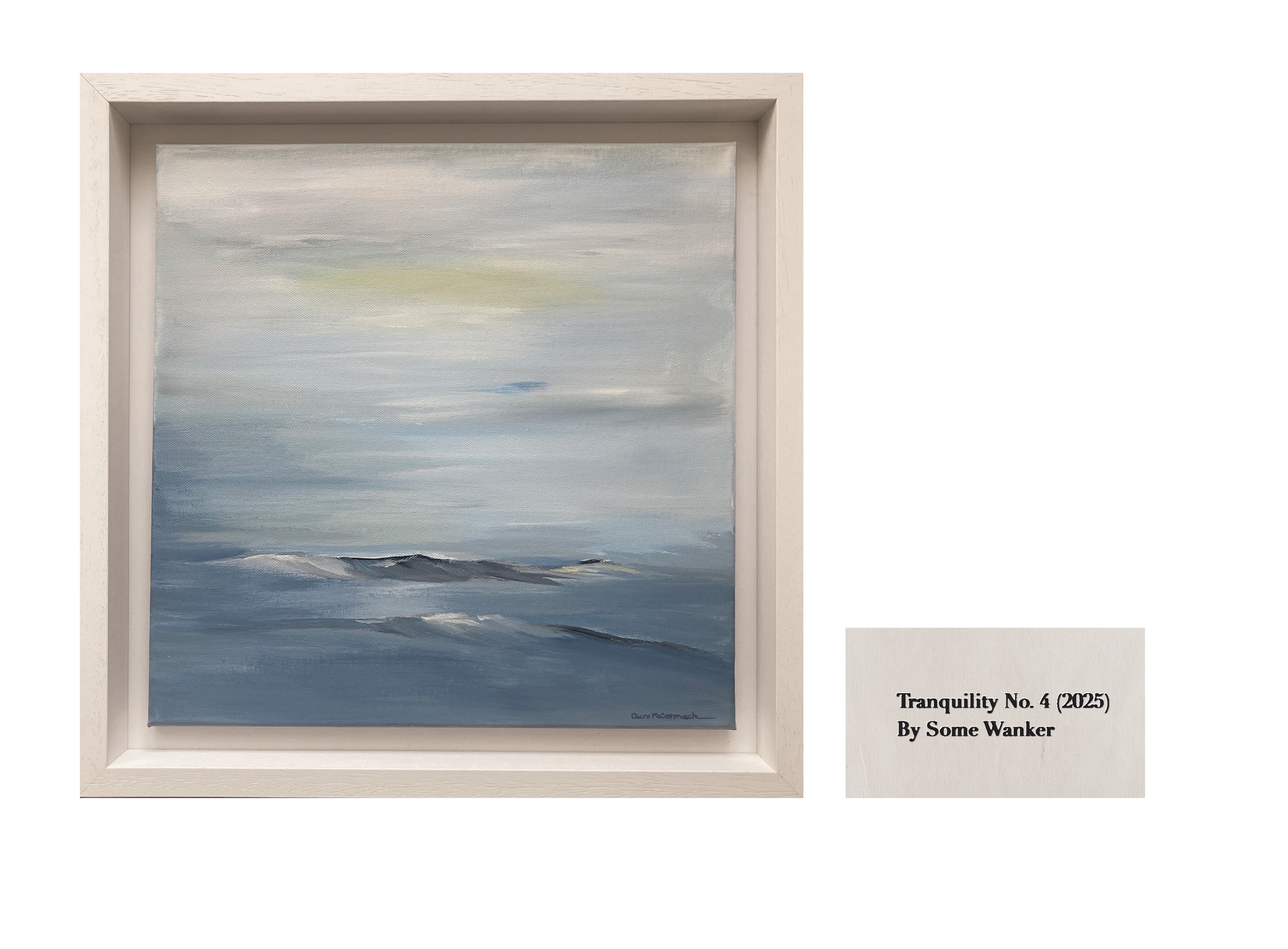
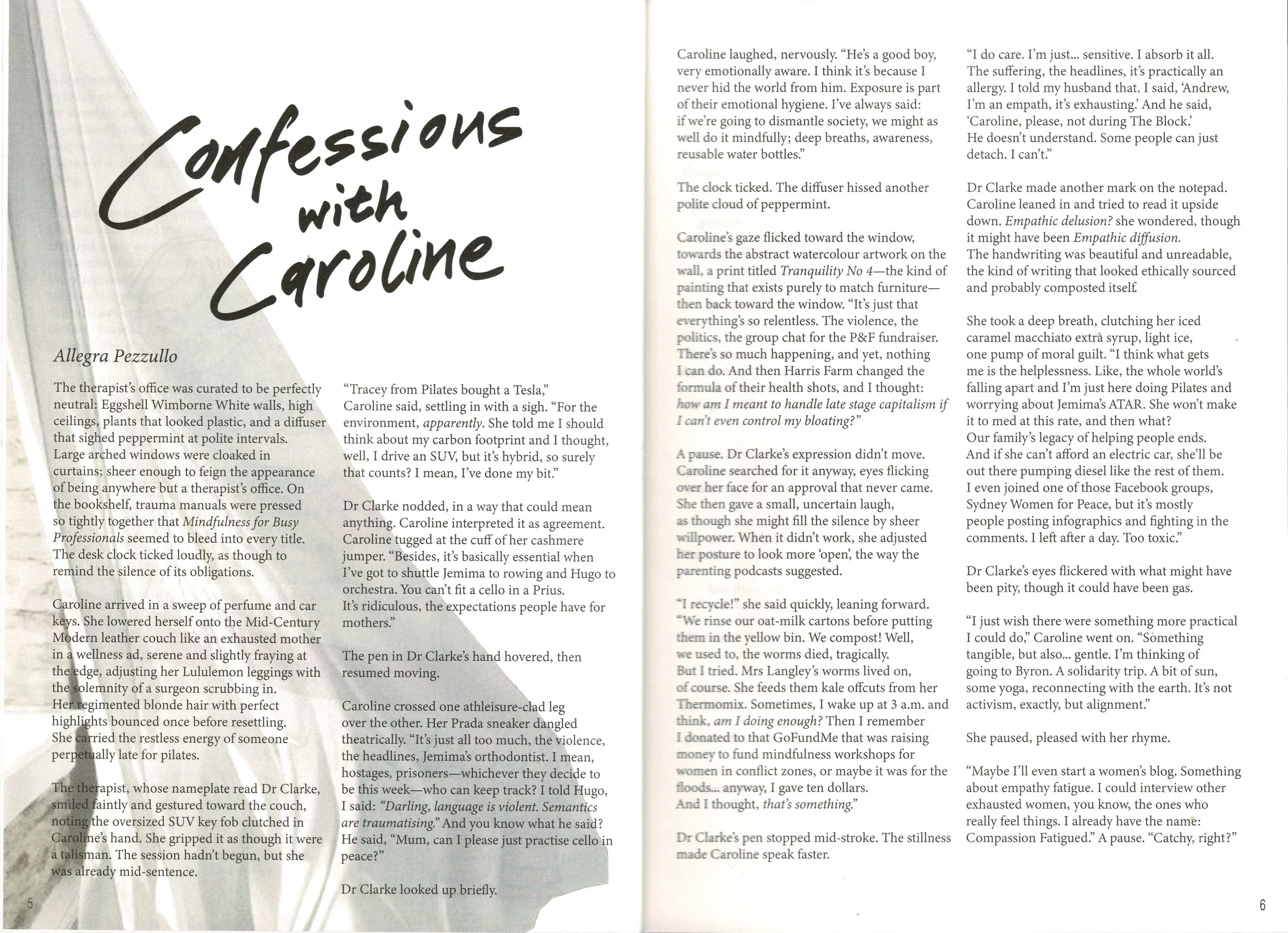
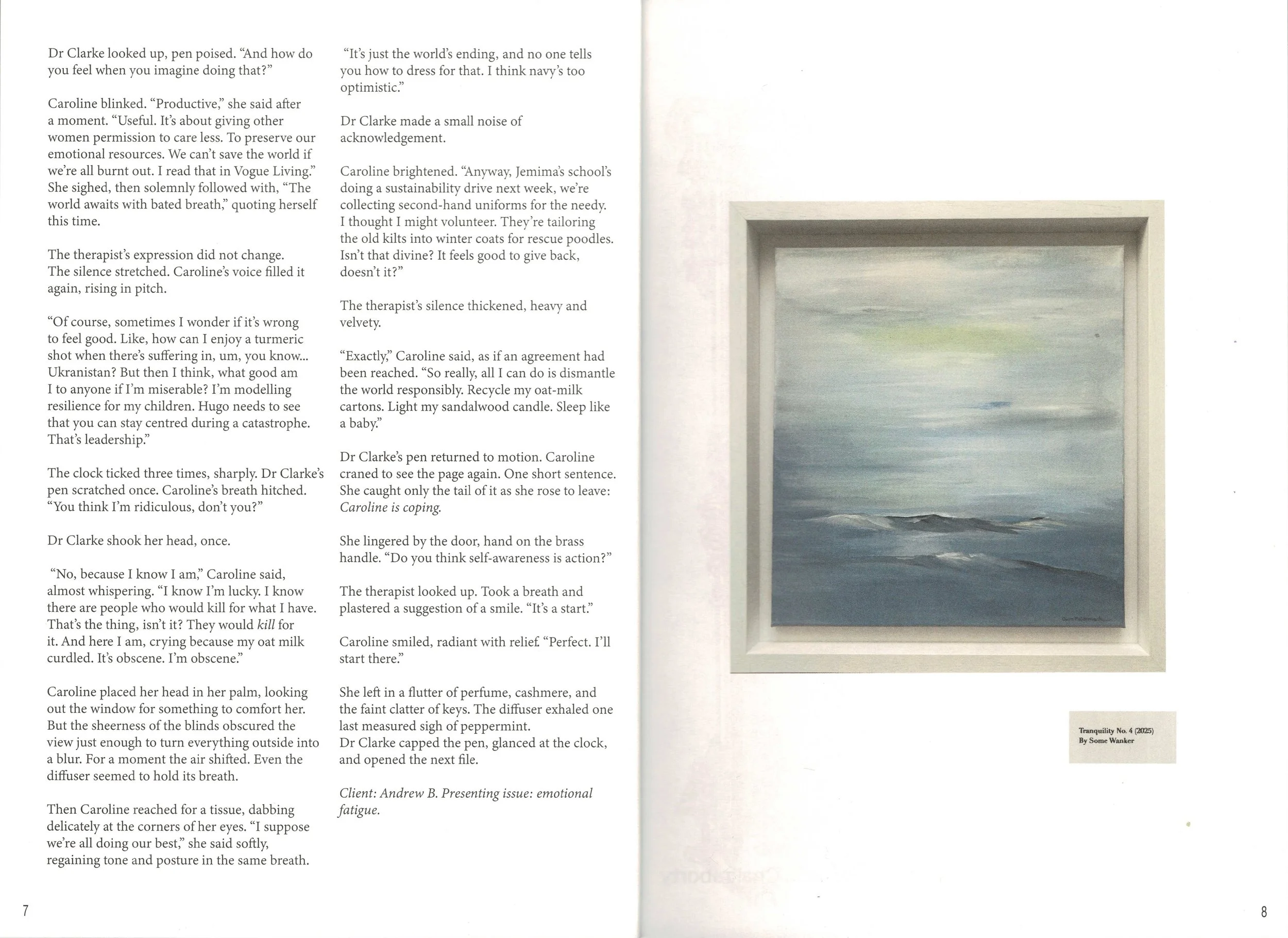
Caroline’s gaze flicked toward the window, towards the abstract watercolour artwork on the wall, a print titled Tranquility No 4—the kind of painting that exists purely to match furniture—then back toward the window. “It’s just that everything’s so relentless. The violence, the politics, the group chat for the P&F fundraiser. There’s so much happening, and yet, nothing I can do. And then Harris Farm changed the formula of their health shots, and I thought: how am I meant to handle late stage capitalism if I can’t even control my bloating?”
A pause. Dr Clarke’s expression didn’t move. Caroline searched for it anyway, eyes flicking over her face for an approval that never came. She then gave a small, uncertain laugh, as though she might fill the silence by sheer willpower. When it didn’t work, she adjusted her posture to look more ‘open’, the way the parenting podcasts suggested.
“I recycle!” she said quickly, leaning forward.
“We rinse our oat-milk cartons before putting them in the yellow bin. We compost! Well, we used to, the worms died, tragically. But I tried. Mrs Langley’s worms lived on, of course. She feeds them kale offcuts from her Thermomix. Sometimes, I wake up at 3 a.m. and think, am I doing enough? Then I remember I donated to that GoFundMe that was raising money to fund mindfulness workshops for women in conflict zones, or maybe it was for the floods… anyway, I gave ten dollars. And I thought, that’s something.”
Dr Clarke’s pen stopped mid-stroke. The stillness made Caroline speak faster.
“I do care. I’m just… sensitive. I absorb it all. The suffering, the headlines, it’s practically an allergy. I told my husband that. I said, ‘Andrew, I’m an empath, it’s exhausting.’ And he said, ‘Caroline, please, not during The Block.’ He doesn’t understand. Some people can just detach. I can’t.”
Dr Clarke made another mark on the notepad. Caroline leaned in and tried to read it upside down. Empathic delusion? she wondered, though it might have been Empathic diffusion. The handwriting was beautiful and unreadable, the kind of writing that looked ethically sourced and probably composted itself.
She took a deep breath, clutching her iced caramel macchiato extra syrup, light ice, one pump of moral guilt.
“I think what gets me is the helplessness. Like, the whole world’s falling apart and I’m just here doing Pilates and worrying about Jemima’s ATAR. She won’t make it to med at this rate, and then what? Our family’s legacy of helping people ends. And if she can’t afford an electric car, she’ll be out there pumping diesel like the rest of them. I even joined one of those Facebook groups, Sydney Women for Peace, but it’s mostly people posting infographics and fighting in the comments. I left after a day. Too toxic.”
Dr Clarke’s eyes flickered with what might have been pity, though it could have been gas.
“I just wish there were something more practical I could do,” Caroline went on. “Something tangible, but also... gentle. I’m thinking of going to Byron. A solidarity trip. A bit of sun, some yoga, reconnecting with the earth. It’s not activism, exactly, but alignment.”
She paused, pleased with her rhyme.
“Maybe I’ll even start a women’s blog. Something about empathy fatigue. I could interview other exhausted women, you know, the ones who really feel things. I already have the name: Compassion Fatigued.” A pause. “Catchy, right?”
Dr Clarke looked up, pen poised.
“And how do you feel when you imagine doing that?”
Caroline blinked.
“Productive,” she said after a moment.
“Useful. It’s about giving other women permission to care less. To preserve our emotional resources. We can’t save the world if we’re all burnt out. I read that in Vogue Living.” She sighed, then solemnly followed with, “The world awaits with bated breath,” quoting herself this time.
The therapist’s expression did not change. The silence stretched. Caroline’s voice filled it again, rising in pitch.
“Of course, sometimes I wonder if it’s wrong to feel good. Like, how can I enjoy a turmeric shot when there’s suffering in, um, you know... Ukranistan? But then I think, what good am I to anyone if I’m miserable? I’m modelling resilience for my children. Hugo needs to see that you can stay centred during a catastrophe. That’s leadership.”
The clock ticked three times, sharply. Dr Clarke’s pen scratched once. Caroline’s breath hitched.
“You think I’m ridiculous, don’t you?”
Dr Clarke shook her head, once.
“No, because I know I am,” Caroline said, almost whispering. “I know I’m lucky. I know there are people who would kill for what I have. That’s the thing, isn’t it? They would kill for it. And here I am, crying because my oat milk curdled. It’s obscene. I’m obscene.”
Caroline placed her head in her palm, looking out the window for something to comfort her. But the sheerness of the blinds obscured the view just enough to turn everything outside into a blur. For a moment the air shifted. Even the diffuser seemed to hold its breath.
Then Caroline reached for a tissue, dabbing delicately at the corners of her eyes.
“I suppose we’re all doing our best,” she said softly, regaining tone and posture in the same breath. “It’s just the world’s ending, and no one tells you how to dress for that. I think navy’s too optimistic.”
Dr Clarke made a small noise of acknowledgement.
Caroline brightened.
“Anyway, Jemima’s school’s doing a sustainability drive next week, we’re collecting second-hand uniforms for the needy. I thought I might volunteer. They’re tailoring the old kilts into winter coats for rescue poodles. Isn’t that divine? It feels good to give back, doesn’t it?”
The therapist’s silence thickened, heavy and velvety.
“Exactly,” Caroline said, as if an agreement had been reached.
“So really, all I can do is dismantle the world responsibly. Recycle my oat-milk cartons. Light my sandalwood candle. Sleep like a baby.”
Dr Clarke’s pen returned to motion. Caroline craned to see the page again. One short sentence. She caught only the tail of it as she rose to leave: Caroline is coping.
She lingered by the door, hand on the brass handle.
“Do you think self-awareness is action?”
The therapist looked up. Took a breath and plastered a suggestion of a smile.
“It’s a start.”
Caroline smiled, radiant with relief.
“Perfect. I’ll start there.”
She left in a flutter of perfume, cashmere, and the faint clatter of keys. The diffuser exhaled one last measured sigh of peppermint. Dr Clarke capped the pen, glanced at the clock, and opened the next file.
Client: Andrew B. Presenting issue: emotional fatigue.
Designed by Sophie Wishart