
I Saw God at Cameron Winter
My fifty-something, FBi-radio-listening mother now knows who Cameron Winter is. “Wow,” she said before I left on Monday night, “Those are some pretty hot tickets!”
And thus rockstars are born. Nick Cave described Winter, the 23-year-old singer, songwriter, and Geese frontman, as “a racked and wondrous thing.” (April 2025) New York Times and New Musical Express critics have descended into similarly rapturous praise, and alternative young men across the world seem to be having some kind of spiritual awakening. On the back of a Laneway festival circuit with his band, Winter returned to Sydney for one night only: a set at the Sydney Opera House’s Concert Hall.
It feels important to mention that I was premenstrual and hungover, and it was in this state of fragility that I entered the night. As I caught the 333 down Oxford Street my bus picked up more and more people in Japanese selvedge denim, joining me on the pilgrimage to Circular Quay. We carved a path through the city, snaking all the way down to the soaring wings of the Opera House—our church for the night.
Obviously, everyone wore black. Amongst the mix of twenty-and fifty-somethings the only pops of colour were Freitags, and all the men looked the same (like Winter himself). There could be nowhere more fitting for Winter than the Concert Hall. His stratospheric rise to fame, both as part of his band and following the release of his solo album, has people treating him as Bob Dylan reborn. This Opera House show was expected to be a repeat of his performance at Carnegie Hall in New York: stripped bare of everything but the music and a sense of cultural occasion.
As we took our seats high in the stands it was difficult to shake this feeling of ceremony and momentum. And then he came out.
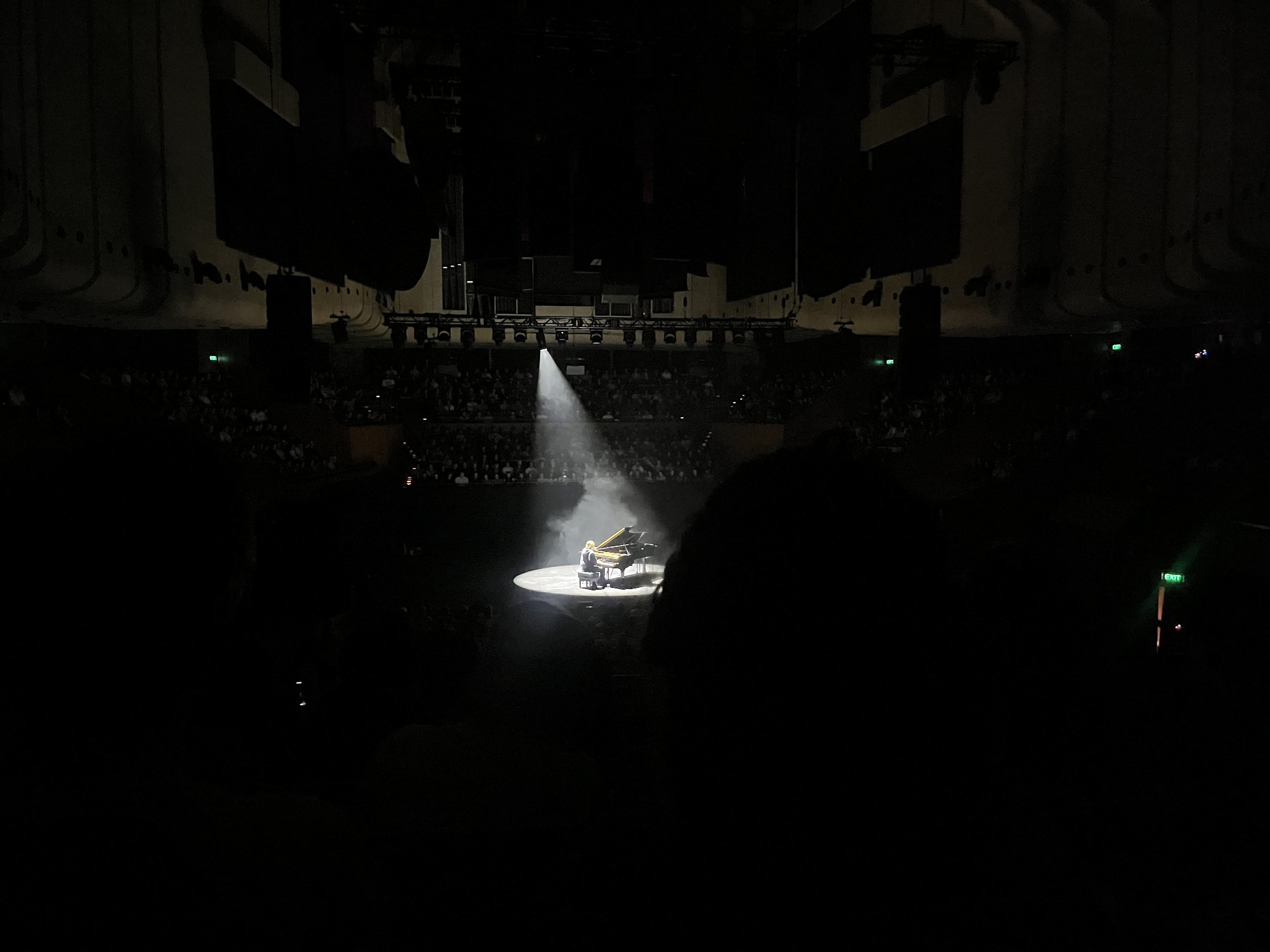
Shuffling onto stage wearing a hoodie, Winter might embody all the stereotypes of an indie male auteur. But as he sat down quickly at the grand piano, shoulders curved to his ears, I got it: his irreverence belies a real sense of emotional depth and intensity, the trembling current before it tows you under.
He opened with ‘It All Fell in the River’, followed by ‘Try As I May’, and ‘Emperor XIII in Shades’. Winter and his piano were lit only by a spotlight, the darkness occasionally intercut with camera flashes from the audience. The applause was strong in between songs and only stopped when Winter played the notes of his next one. I felt keenly, utterly, demonstrably broken open.
It felt like he was singing into my heart. By the time we got to a stripped-back version of ‘Love Takes Miles’ I was breaking out into sobs, as were the people around me. All the while, Winter appeared not to observe the audience—we seemed incidental. The crowd’s desire to have him notice us, share this experience with us, was palpable, resulting in this exchange.
PERSON ONE:
I love you Cameron!
PERSON TWO:
I love you more!!
PERSON THREE:
I love you three!
PERSON FOUR:
Bleughbleughbleughbleurghblah!
WINTER:
(Still facing the piano) I don’t speak Australian.
At times darkness completely obscured him, his outline decorated by angles of shadow shifting over the piano. But during the outro of ‘$0’ the lights of the entire venue came on, revealing us to each other, blind and reeling. ‘God is real,’ he sang. We gave him a two-minute standing ovation before he returned for an encore, ‘Take It With You’. After that, he did not look back.
My face was itchy from dried-down tears. We filed onto the steps, emotionally stunned. Watching him filled me with a strange sense of vertigo. This was someone about to take over the world. The night felt less like a performance and more a ritual, a ceremony that demands: experience this, at precisely this point in unrepeatable time, right now.
I don’t know if what I felt was God, community or catharsis. Or if I just needed, in my acutely vulnerable state, to cry. Yes, the tone of discussions surrounding Winter is approaching reverence; this author is no exception. But sometimes it feels as though our world is missing something indefinable yet crucial, and that auditorium is where we went to rediscover it.
To Winter, fame itself seems incidental, secondary to the pleasure (and necessity) of making music. Perhaps the only thing he needs us to do is bear witness.