
"The bikini, the first anatomical bomb"

Brigette Bardot, 1952 during the filming of Manina, la fille sans voiles (Manina, the Girl in the Bikini) in Cannes. She was aged seventeen. This was one of the first instances of the bikini in film.
Between 1946 and 1958, the United States conducted 67 nuclear tests in the Marshall Islands, 23 of which took place at Bikini Atoll. They named it Operation Crossroads because the US military considered mankind to be at exactly that: a palpable turning point in history. The Islands were selected for their remote location and minimal inhabitation. But Bikini was home to several dozen Marshallese people, who were relocated to nearby island, Rongerik. The Crossroads testing was proposed to the inhabitants as "the good of mankind and to end all world wars." The then leader, King Juda, announced, "We will go believing that everything is in the hands of God." What followed was about 7,000 times the force of the Hiroshima “Little Boy” bombing of 1945. A US navy spokesman described the atrocity through a string of almost unimaginably upbeat euphemisms:
"Rongerik is much more beautiful and is a richer island than Bikini. Coconuts here are three or four times as large and food is plentiful.”
The fall-out was catastrophic: an ongoing culmination of suffering, land dispossession and cultural decay, all “for the good of man-kind.”
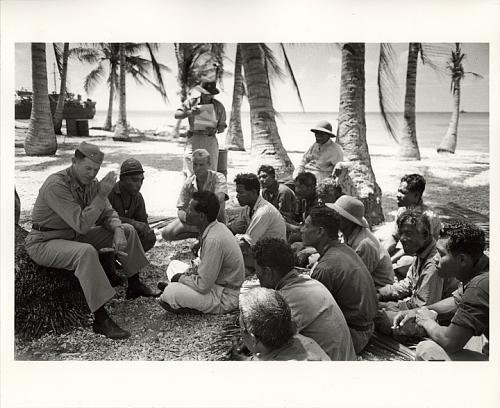
“Bikini Island: Commodore Ben H. Wyatt addresses the natives”
Sourced from the American History Museum, taken by Carl Mydans, 1946
Australia’s history is checkered with an imperial legacy of devastation and dispossession. From 1952 to 1963 British forces conducted nuclear testing in Maralinga Tjarutja, South Australia. The Traditional Anangu custodians were not consulted prior, and instead were cast-off and prohibited from the area. Though over the years many still passed through the land during the testing period, they called it “Mamu Pulka”, Pitjantjatjara for evil spirit place. It was a site of suffering, both in regards to the horrific defects and disease, and the spiritual ruptures that cut across the very fabric of First Nations ontology. Beyond the hazardous health conditions, it was an act of cultural violence.
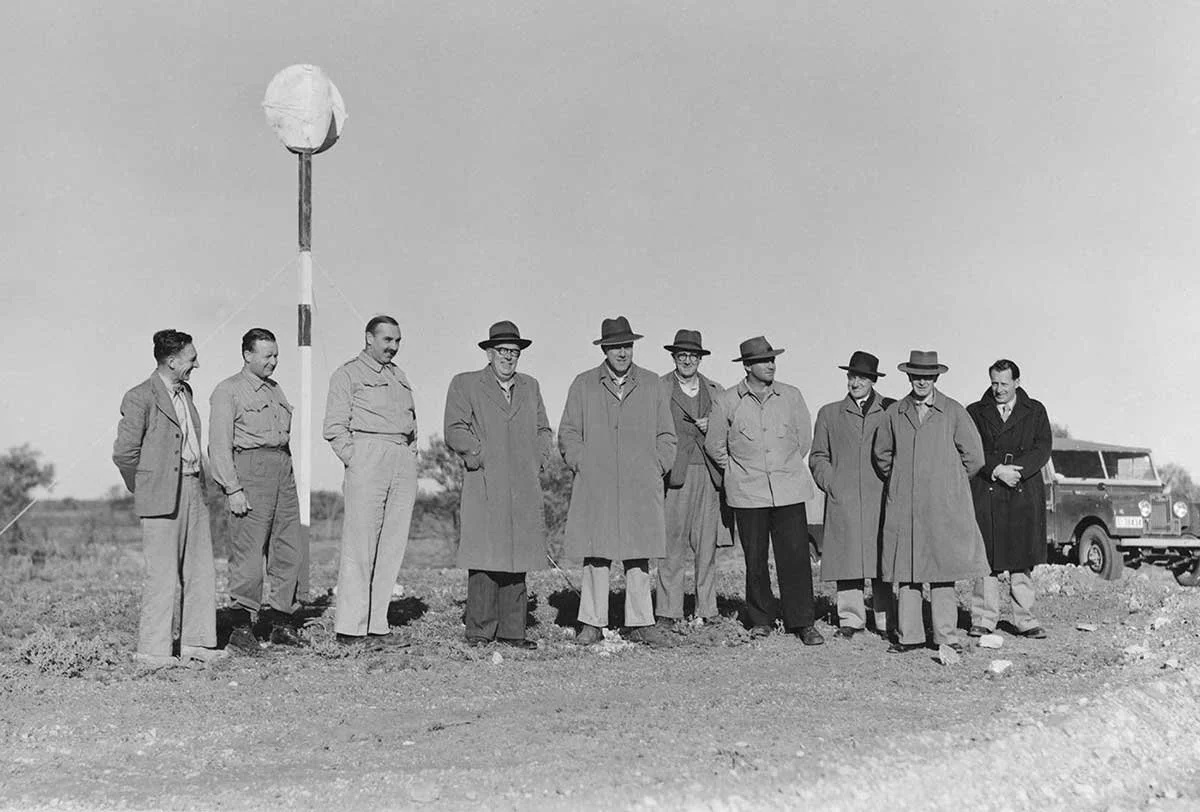
Sourced from the National Museum Australia
The West’s nuclear innovations were a phallic symbol of triumph, a potent affirming of the (masculine) nation. In her 1987 essay Sex and Death Carol Cohn compared the contents of Air Force Magazine to that of Playboy: terms like “thrust”, “penetration” and “big stick” were used to promote weaponry, suffused with sexualised imagery. The Cold War was an eroticised pursuit for dominance. The enemy, whether imagined or materialised, foreign or intimate, could be destroyed only through hypermasculine strength. And the subjugation of the colonised. As Historian Alex Wellerstein wrote for The New Yorker in 2016: “The Crossroads tests were the beginning of one of the more disturbing American nuclear legacies—a trade of flesh for knowledge.” And what is fashion but a trading of flesh? That same year testing began at Bikini Atoll, two French designers, Jacques Heim and Louis Réard, separately introduced their new swimsuit designs: le Atome, and le Bikini. Both men sought to capitalise on the shock value of the Atomic Age, to incite the same horror at the raunchiness of the female body. It was sexy, it was itsy-bitsy-teenie-weenie, it was loved (Réard allegedly received fifty thousand letters from gleeful men) and it was hated. A preoccupation with something imagined, something provocative, that arouses yet unsettles, very Cold War, no?
The female body is the site of this impulse: the enmeshing of desire and destruction. Two decades before Bardot’s bikini scandalized the world, Missourian actress Jean Harlow helped popularise militaristic eroticism in the films Platinum Blonde (1931) and Bombshell (1933). She became a machine of pleasure: seductive, explosive. Now such language is associated more with Love Island than the atrocities in the Pacific Islands. But its endurance encapsulates the ideological contradictions of warfare: attempting to master one’s own means of annihilation. One of the bombs detonated at Bikini Atoll was nicknamed Gilda, after Rita Hayworth’s titular performance in the 1946 noir. Her image was painted on its surface. There has always been something alluring about destruction, and something destructive about chasing this allure. As Donna Tartt wrote in The Secret History (1992): “Beauty is terror. What we call beautiful, we quiver before it.” Why are we turned on by terror?
Perhaps the female body, as a symbol of this existential conundrum, becomes the means of regimenting it. Man creates bikini/bomb, and is enamoured with the power it/he yields, yet unsettled by its capacity to destroy. The bikini (-clad body) is malleable to the same colonial gaze which coded Bikini Atoll and its inhabitants as dispensable. So the macabre fascination with destruction found its material form.

Oh, these weapons of mass destruction really get me down! Pictured: Miss Atomic Bomb, 1955 (Anna Lee Mahoney)
This looming threat of annihilation became a spectacle: violent devastation was displayed through glamour. Prudence Glynn in her 1982 Skin to Skin: Eroticism in Dress wrote: “Fashion is always at its most provocative during or after times of war.” And yet how many truly know the origin of the bikini? Its invention merely encoded a frivolity into the legacy.
Anthropologist Daniel Miller argues that at the heart of Western philosophy is an ontological preoccupation with depth. This forms the common-sense assumption that anything on the surface is superficial and lacking importance, and that something profound lies underneath. Therefore, the sexualised body functions as an ahistorical site of erasure: we do not permit it a deep, legible interior. The delightful vulgarity of a scantily clothed beach-goer makes digestible the harrowing nature of eroticised terror. Consider the irony of me saying, it is that deep! By denigrating the body’s surface as shallow we no longer have to interrogate the intersection between desire and danger. We accept the ubiquity of the bikini, and we divorce it from its origins. We observe a polka-dotted history of puritanical outrage, body positivity, polyester, and we make malleable the skin that displays it. But we do not give much thought to those of Bikini Atoll, who had no words to make sense of the nuclear fall-out, and what was happening to their children. New words began to emerge, like “jellyfish,” for babies born with transparent skin and no bones.
In legends lives a woman. Turned monster from loneliness. Turned monster from agony and suns exploding in her chest. She gives birth to a child that is not so much a child but too much a jellyfish. The child is struggling for breath. Struggling in pain. She wants to bring the child peace. Bring her home. Her first home. Inside her body.
It is an embrace. It is only. An embrace. She kneels next to the body.
And inhales.
Excerpt from “Monster” by Marshallese Poet Kathy Jetn̄il-Kijiner