
Something Grim & Ancient Hung Over An Iliad
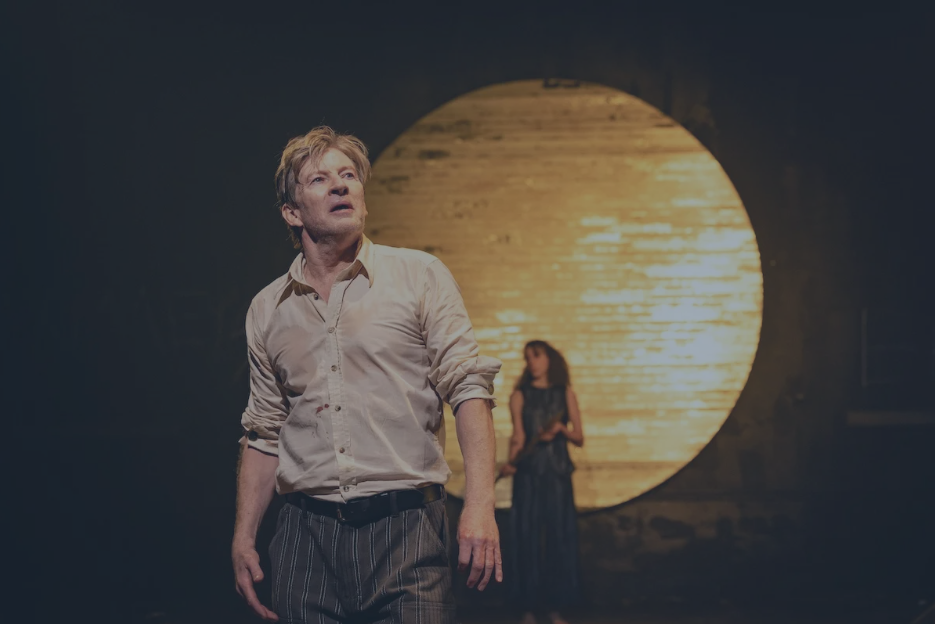
An Iliad: David Wenham as The Poet. Photo © Daniel Boud
After the long drive to Sydney to see David Wenham sing of the famous wrath of Achilles; so intense that it has bonded to his very name, so fuming that it could fuel the flames of perdition; the anticipation for lofty warfare filled the nothingness on my lips. Beyond the sunset from the wharves, a pagan nostalgia surfed the horizon.
I should say that I purposely avoided any and all press related to this play. I knew Homer’s Iliad very well; I have read it; I have written essays on it; I loved Troy (2004)… But there remains the expectation that this inexhaustible work has more to say and, more importantly, more ways to say it. As we ambled blithely across bridges and wound down roadways, there was a ticking fantasy that Damien Ryan’s An Iliad could flourish the winter with beauty and fire.
But the long drive had taken its toll; I was passing out. I entered Wharf 1 Theatre, surrounded on all sides by theatre kids and older connoisseurs, worrying lest I nod my head over the performance and miss it.
Upon seeing the stage—a rustic corner clothed with dead leaves and slabs of dust and a garage door held by a chain—the dreariness clung to me like dust to my shoe, and I worried that nothing would stop me from falling asleep.
Then David Wenham rolled up the shaft and emerged, wearing a haggard, double-breasted duster and a weary, miserable solitude. His first words marked a religious occasion, and all raised their necks for it. He broadcast the first few lines in Homeric Greek. Back in the day, this utterance would mark a reverent silence ("Whoa, everyone shut up, the bard’s invoking the Gods”), and the same was true here. His voice was marked with a power at once warlike and priestly. This pantheon of gods, thought long dead, had reawakened.
Wenham played The Poet, who has lived through the Trojan War and seems cursed to recount the story until humanity ends its existential tradition of violence. “Every time I sing this song,” he says, “I hope it’s the last time.” He called for the muse in archaic tongues but received no answer. He struggled to tell the story on his own, all while murmuring verses in Ancient Greek. What a pathetic man he has become.
He dragged out his wagon, decked with a double bass, a cooler, chairs, a rack of spirits, and other knick-knacks, and, still mumbling demented Greek phrases, darkness suddenly dropped. A hand reached out from the wagon; the muse had arrived. Wenham then assumed a newfound, empyreal manner and began with a great jovial ceremony.
Helen Svoboda’s experimental music was quite possibly the highlight of the show for me; her mellow vocals heightened the incantatory atmosphere. Pulling and burning frictions against the double bass, or drumming the strings, the acoustics brought to mind a playfulness echoing Johnny Greenwood or an acoustic Vangelis. Svoboda played the muse alongside her musical performance, whispering from the speakers the voice of Athena and various divine figures. Something in her performance got an upper hand of my ear and has shrouded it tenfold with a pagan darkness. Her reverence for this ritualistic occasion was like a mimetic hypnosis. I felt readily spellbound in this mystic world, where gods and men battle on boards of blood and stages of viscera.
There came a moment in the play, when Achilles and Hector were brought into their narratives for their respective roles, where Wenham and Svoboda wrote their names on the blackboard that served as the walls for the stage in the Homeric Greek characters.
Ἀχιλλεύς Ἕκτωρ
Then it hit me: these two figures have, over the course of history, spiritualised into ideas. Seeing those names next to each other, they became something of a magical linguistic vessel that contained their deeds, their stature, their personalities. Such was the power that those two words cast upon us, brighter than the stage lights. It seemed there was in fact a kind of spiritual presence, notwithstanding the fact that these two people likely never existed. These two names could carry the mythical weight that bore upon them with an immensity that had stunned the microscopic universe in that theatre.
I can recall a myriad of other memorable images: Wenham setting fire to Achilles’ helmet, signifying the forging of his new divine armour; The Poet carrying the double bass back to the cart, a poignant symbol for a lifeless Hector; Achilles’ shield rising up from the floor like a second sun, from then on representing the divine figure himself. But elevating the descriptions to a sublime status would be a disservice both to the play’s style and larger theme.
As The Poet packed up his things to conclude the story, he listed the hundreds of human conflicts—the Punic and Gallic Wars, the Mongol conquests, the Crusades, Cromwell’s conquests, the American and French Revolutions, the Napoleonic Wars, the First and Second World Wars, the myriad of Cold War conflicts throughout history. It may shock some just how long this monologue goes on for, and suspirated sighs could be heard all across the audience. We were reminded of that key line near the opening: “Every time I sing this song, I hope it’s the last time.”
Perhaps the greatest and most tragic irony is summed up by TheSydney Morning Herald’s praise for this performance: “We’ll be talking about this play for years to come.” I suppose, then, that our poor and lonely man will be doomed to wander on with his song clutching to him, refusing to let go.