
PASSION 4 FASHUN: Ontology of the slippage (of sorts)
Let me elucidate: I know I shouldn’t be so comfortable sitting right up against strangers on the bus. City etiquette. Especially in this heat, then this snow, this dandruff-raining climate change. Things are bad, you know. They’ve been saying this for a while now. Ash will gain momentary structure, of course, before settling on us as we begin coughing and spluttering all over each other, but I digress already! What I mean to say is that often I can close my eyes and let the side of my body slip up against a stranger’s side. Only momentarily. For a brief moment in that darkness, bus-coloured darkness, I can find an eroticism in the texture of unknowable touch. I can’t exactly place my finger on what it is. A scribble of an outline rather than any harsh lines, but it’s there, wavering, pulsating in the coat pocket of the human sat next to me. A model emerges.
She asks “...Have you been sleeping okay?”
“No,” I tell her. “I haven’t.”
I haven’t. I’ve been falling asleep reading documents on fashion metaphysics, a little hallucinatory from all the 528hz sounds and incense smoke I’ve been burning. I wake in a dream wherein a backless dress approaches me from the bar and asks if she can buy me a drink. I oblige.
She asks, “Are you thinking again about the symbolic dimensions of clothing beyond its material form or would you like a martini?” and I wake.
Cold sweat. Hot sweat. No sweat.
I make it to the grocery store in time to buy discounted roses which I pick the leaves and thorns off of to place in a brass vase, to place on my desk and admire. They are decaying (see Fig 1). I notice one of them is worse off than the others, this ugly-duckling of a rose with an abscess in the side of its mouth, and the closer I look the closer I come to realise it’s not an abscess at all but a slippage of sorts, a strap fallen down the shoulder of the mannequin, a hole, a burrow, and in that burrow lives a woman, and in that woman lives a—
Second skin. A blatant mask, if you will, in order to create the never-naked body of you and me and everyone we can think of. A bridge between the physical form and the intangible roots of identity.*
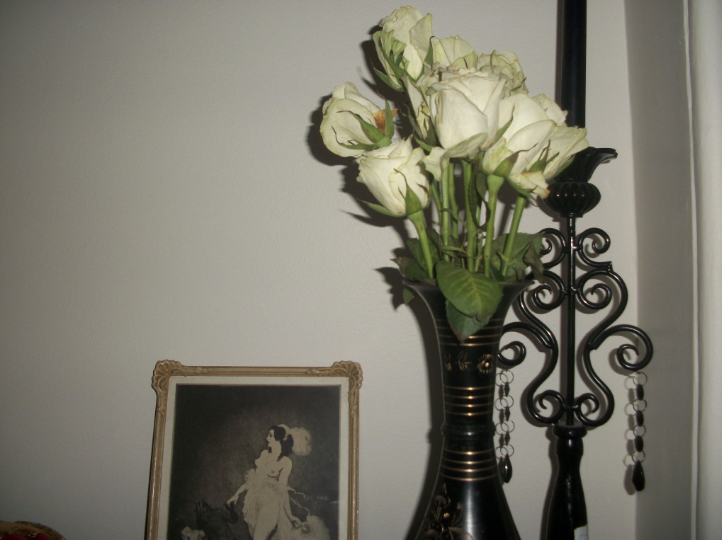
Fig 1. Woman living in my white rose.
Spent $10. Not sure how much rent she pays but she sure is living it up. Tomorrow they’re delivering an upholstered red velvet armchair for her to rest her feet on while she lounges in her upholstered blue velvet armchair. They really should mandate these kinds of things.
I put the documents down last night. Heavy reading… in need of something lighter. Heidegger? Perfect. A little something like:
Being is not permanent or fixed but rather a dynamic and ever-moving event of presencing or appearing. The event—in order to exist as an event and not any other form of circumstance—requires a constant interplay with Absence.** For example, a hammer tends to only make sense in a network of mostly unseen relationships. We see then, the nails, the wood, the carpentry. The vast majority of this network is ‘absent’ from our immediate focus, yet it enables the object to be understood. Moreover, some objects are defined by their absence… by their lack of. Object defined by a cavity. The washing machine is hollow on the inside (see Fig 2.). So is the urn. The function of these objects depends on their absence of, and it is within this absence that we find something else entirely. I think once more about fashion metaphysics. I pull up the documents.
If fashion, in essence, becomes a way in which existence reveals itself, then it’s a kind of revelation that will still always involve concealment. To conceal the body, to bury it, to direct its absence into a tailored suit, reveals a sense of status, but it simultaneously consoles bodily irregularity and the labour behind production. Fashion as…
Ontology?
Yes. The removal of. Think about negative space as essential for creating the erotics of fashion metaphysics. How else would we adore the mid-drift? The low-rise jean? The boob-tube? An erotica of absence… it’s all semiotics, it’s all sex, it’s all:
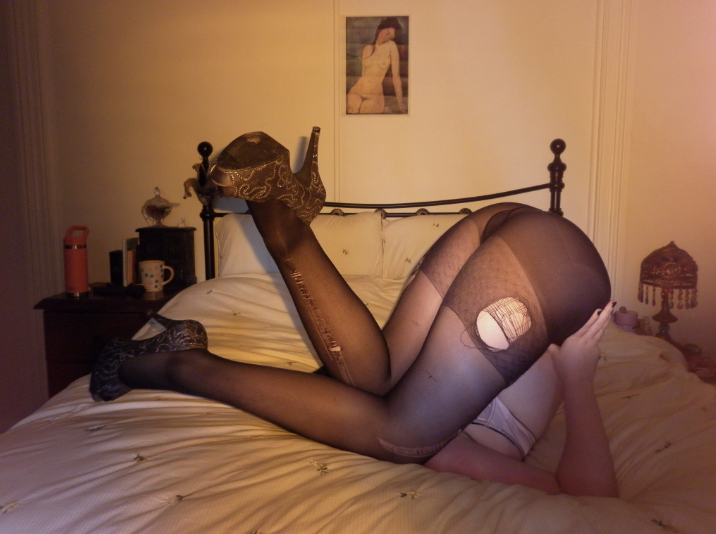
Fig 2. Cavity of the Washing Machine.
Had to take my quilt to the laundromat after last Saturday night; the extent of the thing wouldn’t fit in my own washing machine. I lugged it down there in a removalist bag and put it on a spin cycle. $18. Twenty-four minute wait and I discovered an organic grocer across the road playing Alanis Morrisett. This is it, I thought, This Is Where I Am Meant To Be. Amongst The Persimmons. Woman behind the counter tried to sell me sea moss to fix my complexion. I bought a new toothbrush and chocolate-covered coffee beans. “How do you eat those?” my housemate asks, “just like…swallow the coffee bean?”
In my dream Heidegger comes to me shirtless and sweating on horseback. I ask him where he learned to ride like that. His face is made of triangles and shapes I cannot draw. A man made of elbows. A sun sets in the distance. He says "...you know...it's actually the absence of the thing, of the object, that makes it what it is. Your biological hollowness...the (w)hole of your sex is defined by the fact it is a cavity.”
He doesn’t know what I am. He’s not even looking at me.
“I’m not a feminist,” I say. “I am trying to write about clothes and metaphysics, you’re changing the subject—”
“I’ve never seen you post a political infographic on your Instagram story. Are you sure? You are pretty—”
Absent, I am pretty absent. I am categorised by my absenteeism on the surface of the digital planet. Is that right? Man On Screen is trying to sell me a filter for my kitchen tap because it’s filled with toxins we didn’t know existed in the 1970s. Man On Screen tells me it’s probably a good idea to start selling pictures of my feet. Man On Screen generates an image of Heidegger on a horse for me and tells me I’m doing a good job.
*From the corner of my room Oscar Wilde says “A fashion is merely a form of ugliness so absolutely unbearable that we have to alter it every six months!” Tut tut.
** ‘Absence’; the state of being away from a noun. See also; ‘abscess’ – a swollen part of bodily tissue containing an accumulation of pus; which, when drained, creates an absence. Remember? Yeah. Refer to Fig 1.